
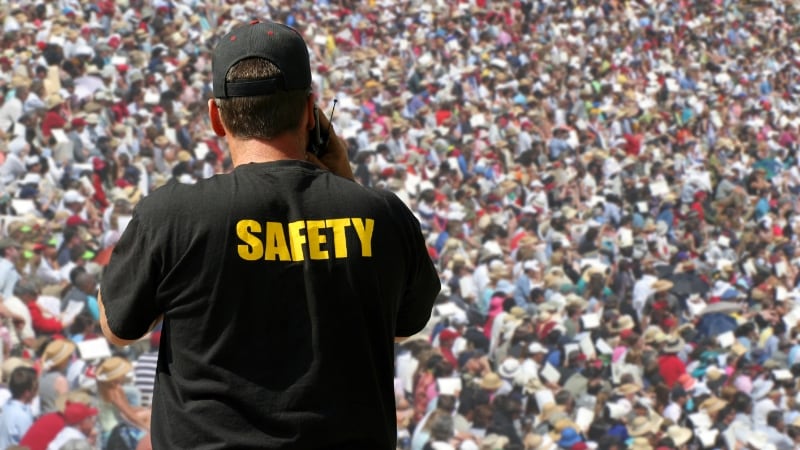
Providing security for high-profile clients often means working at major public events. Concerts, premieres, fundraisers, rallies, and conferences all add layers of unpredictability. But a structured plan of action turns that chaos into manageable risk. With the right preparation and crowd management best practices, you can better protect your client, reduce their exposure to instigators, and keep the event running smoothly.
What is crowd management?
Crowd management is the planned, coordinated process of guiding people safely through an event space while maintaining order, preserving normal operations, and protecting high-profile individuals. It begins long before doors open and continues until the last attendee exits. Effective crowd management blends strategy, logistics, communication, and real-time decision-making.
The key elements of an effective plan include:
- Pre-event planning: Map the venue, assess risks, and assign roles before doors open.
- Access control: Use layered checkpoints and credentials to restrict movement to and from authorized zones.
- Communication: Align the team with clear radio protocols, plain-language callouts, and a shared incident log.
- Monitoring: Track density and behavior with cameras, roving patrols, and elevated observation posts.
- Emergency response: Stage routes, rally points, and role-specific actions for rapid medical support or extraction.
Crowd management best practices
To better protect your client during an event, follow these crowd management guidelines:
Understand the crowd you’re managing
Event organizers can better prepare for potential safety concerns by analyzing the behavior and dynamics of different types of crowds. Evaluating key factors such as crowd size and composition as well as potential risks is essential for establishing effective safety measures.
Events often draw a variety of crowds, each with unique traits that call for specific strategies. Here are some common crowd types to consider:
- Casual: Relaxed attendees moving at an unhurried pace
- Controlled: Seated or segmented audiences with predictable flow, often with a lower risk of incidents
- Dense: Audience with limited personal space and slow movement, increasing the risk of crowd crush and chaotic altercations
- Excited: Crowd with an elevated energy and sporadic surges toward high-profile individuals, increasing the potential for stampedes and targeted violence
- Hostile: Oppositional groups or individuals with the intent to disrupt the event and potentially cause harm
Minimize direct contact with large groups
When protecting your client in a crowded environment, the safest approach is to minimize direct contact with large groups of people. It’s therefore important to keep your client’s interactions with the crowd brief and focused, maintaining a safe distance at all times. If possible, have your client wear clothing or accessories that make them stand out from the rest of the crowd, making it easier for you to keep an eye on them.
Surveil for suspicious behavior
Look for behaviors that deviate from the environment: counter-flow movement, loitering at entrances, repeated scanning of exits, handoffs, or filming of security routines. Using video analytics and AI countersurveillance tools can help you flag abnormal density, fast-forming clusters, or perimeter breaches.
Shape behavior with the environment
Barriers and controlled corridors can block and guide crowds so that surveillance is unobstructed and people move naturally. Use serpentine lines to reduce surges, crowd breaks to relieve pressure near stages, and clear signage that tells crowds where to line up and exit, and which areas to avoid. Controlling the crowd in such a way reduces their unnecessary interactions with high-profile individuals and minimizes opportunities for harm.
Coordinate with your team
Managing large crowds while protecting your client or event requires coordination and communication among all members of the security team. Utilizing technology such as radios, earpieces, and a central command center can help facilitate real-time communication, allowing for quick responses to any potential threats. Use brief, standardized voice codes for common events (gate hold, surge, breach, medical) so that everyone is on the same page and can act quickly and efficiently.
Be mindful of your weapon
While a weapon may be necessary for some security professionals, always keep it secure and out of sight. If an event becomes chaotic, losing control of your weapon can have serious consequences. Ensure that you are properly trained and licensed to carry a weapon, and always follow proper safety protocols. It is also crucial to remember that the presence of a weapon can escalate a situation, which is why you should avoid brandishing it unless a hostile attack or threat is imminent.
Act the moment boundaries are crossed
Instigators looking to cause trouble may push boundaries to incite a reaction. As a security professional, it’s essential to stay calm and composed in these situations. Act immediately when someone crosses the line and intervene before the situation escalates further. This could involve using verbal de-escalation techniques or physically removing the individual from the area if necessary.
Prepare for physical altercations
If a physical altercation breaks out, it’s important to know how to defend yourself and restrain individuals so they don’t harm your client or themselves. Hand-to-hand combat, disarming, and grappling techniques are invaluable skills for a security professional. Make sure to keep up with your training, and regularly review and practice these techniques to stay in top condition.Careful planning, sharp communication, and disciplined crowd shaping preserve safety around your client while keeping the event enjoyable for everyone. For deeper training on crowd management and de-escalation, reach out to Aspis Training Center today.